How to Manage Muscle Pain While Running
Although the title of this blog mentions the management of muscle pain while running, the majority of running related injuries that have to do with muscle actually occur at the tendon. A tendon connects the muscle to bone. For the purposes of this blog we’re going to group these two soft tissue structures together.
What muscles/areas work the hardest while running?
Calf complex (soleus and gastroc)
Quads (vastus group, rectus femoris)
Lateral hip (glute medius)
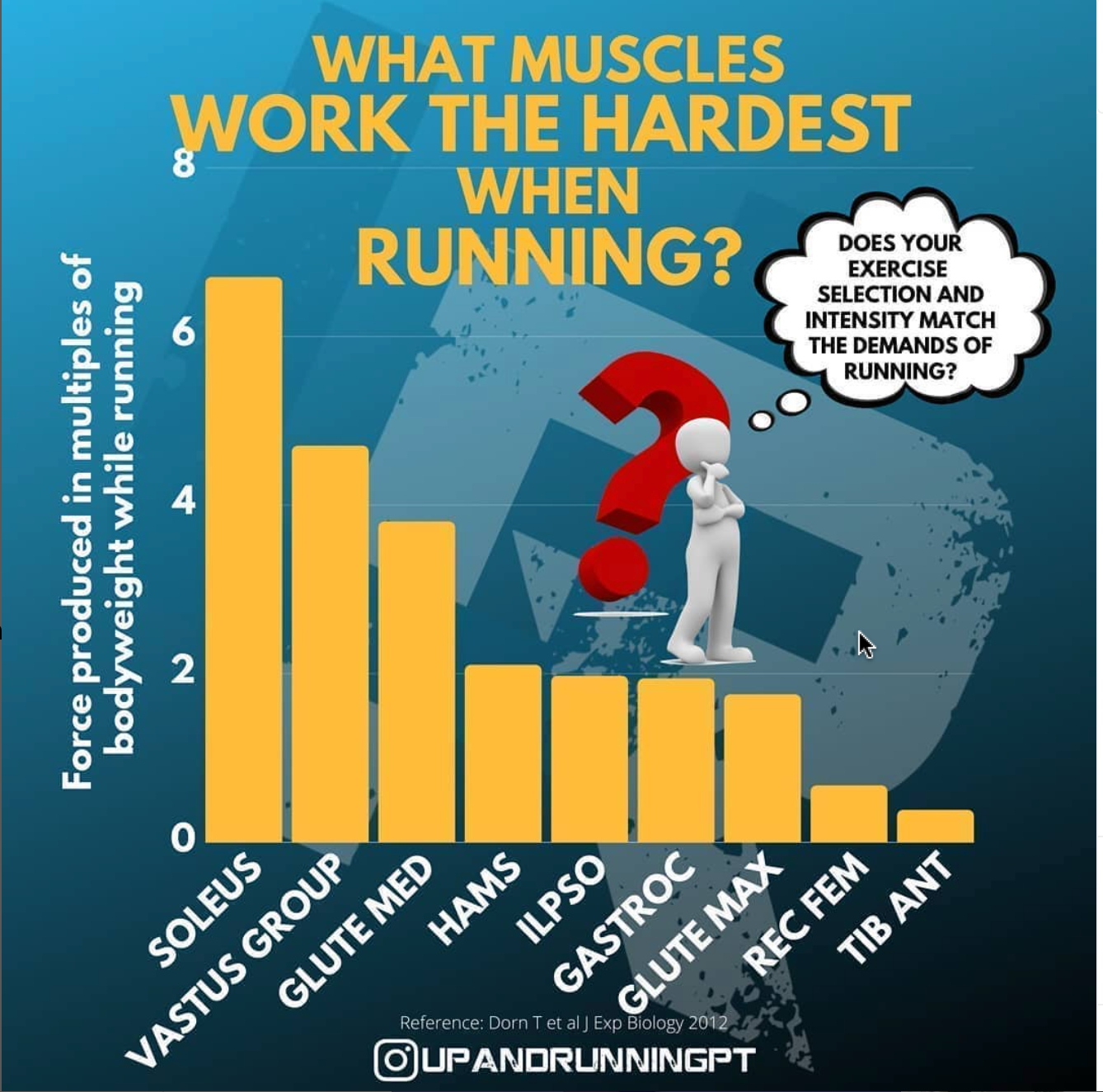
The reason it’s beneficial to know what muscles work the hardest is because these are the same tissues that tend to have higher rates of injury. For example, Achilles tendon pain and quad tendon pain are very common injuries in distance runners.
Running Injury or pain while running
Running related injuries occur when the load you’re exposing a tissue to is more than the tissue’s current capacity or capability. Or in simplified terms, you do too much too soon which can irritate a muscle/tendon. As a runner, I understand that most of us want to keep running even when dealing with pain. Below is the guideline I give my athletes to help keep the pain or injury from progressing further.
Pain guidelines:
Tendon/muscle pain:
Keep pain at or below 4/10 while running
Pain is back to baseline 24 hours after run
It is really important to know that you’re actually dealing with tendon or muscle pain before implementing these guidelines. There are other injuries that may feel similar to muscle/tendon pain that should not abide by these recommendations.
Hip Muscle/Tendon Pain
What variables increase stress at the hip?
Hills
Intensity
Trail running: ex- cambered roads
Hip musculature does two major things during running:
Contributes to vertical support (keeps us upright)
Propulsion (moves us forward)
In order to train through hip pain, you should aim to limit variables that would increase stress at the hip. Increased elevation (running uphill), speed work, and trail running due to cambered roads are three variables that increase demand of the hip musculature.
Hills:
When running uphill, muscles in the hip must work harder to propel us forward than when we’re running on flat ground. This is when the calf complex, glutes, hamstrings, and hip flexors contribute the most to long distance running. Decreasing the amount of hills during a run or the steepness of the hills is an easy way to manage the load we’re putting through those muscles and tendons.
Trail Running:
Trail runners are no stranger to hills, nor are they strangers to cambered roads/trails. When running on a cambered trail or major slope, one hip often sits much higher than the other, leading to the need for increased vertical support- meaning that the gluteus medius (lateral hip muscle) has to work harder to keep the hips as level as possible.
Intensity:
Increasing intensity during a run most often refers to increasing pace or adding in speed work. Acceleration requires more work from pretty much all muscle groups in the legs. This is not a bad thing when you’re a healthy runner, but if you’re injured or hurting, this will add more stress to the area that’s injured and could cause irritation. Decreasing your pace or taking out speed work is a good way to manage hip pain while rehabbing and continuing to train.
Knee Muscle/Tendon Pain
What variables increase stress at the knee?
Downhills
Intensity
Higher drop shoes
The knee’s major role in running:
Breaking force (deceleration)
Vertical support (keeps us upright)
When running with knee pain, you can manipulate one of the three variables mentioned above to decrease stress of the muscles (quads) that contribute to breaking forces. Decreasing stress the muscle must tolerate, short term, can help make symptoms more tolerable and keep you running.
Hills:
Unlike the hip, knee pain tends to feel better when running uphill. Downhill is where the knee is challenged the most due to the fact that you have to have more control and breaking force to stop gravity from pushing you forward. You don’t necessarily have to take hills out of your training completely. You can try to run hills that are less steep first to see if that helps lessen symptoms to a tolerable level. If those are still too painful, during or after, then taking out hills short term could be beneficial.
Intensity:
As mentioned above, increasing speed adds stress to all lower extremity muscle groups. Managing stress short term is the best thing you can do to continue to run through knee pain. Running slower or limiting speed work are two of the best ways to limit discomfort during and after a run.
Higher drop shoe:
Now this is one of the last variables I usually address, but it can help improve knee pain short term and is a pretty easy change. The drop of a shoe is the difference in height between the front and back of the shoe. A higher drop shoe is higher in the back than the front. This type of shoe puts more stress on the knee because they increase the amount the knee bends while in contact with the ground and how hard the quad has to work to straighten the knee (1). Wearing a slightly lower drop shoe can help lessen both of those variables and therefore decreases stress on the knee/quads.
Lower Leg/Ankle/Foot
What variables increase stress/load here?
Uphill/increased elevation
Intensity
Lower drop shoe
Lower leg/ankle/foot does two major things during running:
Contributes to vertical support (keeps us upright)
Propulsion (moves us forward)
Hills:
Similar to the hip, the lower leg, ankle, and foot must work harder when running uphill to move us forward. And, since the calf complex (part of the lower leg and ankle) is the hardest working muscle group in long distance running, adding elevation to your runs makes these muscles work even harder. When dealing with muscle/tendon pain in this part of your leg (ex: achilles, posterior tibialis, peroneals, ect) limiting the amount of total elevation and the steepness of the hills you run can be very beneficial.
Intensity:
Hey, look who it is again… Decreasing overall pace and/or limiting speed work or taking it out completely for a time can help you manage achilles/ankle/foot pain. There are multiple options here and you need to find the right one for YOU. If this is something you struggle with, I’d highly recommend reaching out to a PT who specializes in runners to go over your programming with you.
Lower drop shoe:
A lower drop shoe has a rear foot that is more similar in height as the front of the shoe. This causes the muscles of the posterior lower leg to have to move through more range of motion while running, causing increased workload and stress. This stress can be negated by wearing a higher drop shoe or even using a heel lift on the painful side short term.
Being able to manage pain or injury while running/training is important to most runners. I know very few of us who have never dealt with pain when running. There are some injuries, tendon pain being one of them, that improve quicker if we can maintain its tolerance to stress while rehabbing (ie keep running and lifting). Taking running completely out of your plan should be the last resort in my opinion, especially if you can tweak certain variables to decrease your pain. If you’ve been dealing with pain while training and can’t seem to figure out how to keep running or get it back into your routine, schedule a free consultation here to see how PT could help you.
Sources
Rich Willy. Montana Running Lab.