The dreaded stress fracture. An injury no runner wants to encounter. This year I’ve been seeing a huge spike in bone injuries in the lead up to fall racing. The biggest issue is that a lot of runners come into my office thinking they’re in the clear because their doctor ordered an x-ray which showed no fracture. This test is NOT enough to rule out a bony injury. And I’ll tell you why after I give you a little bit of bone background first.
Bone stress injuries (BSIs)
Bone stress injuries occur when bone damage accumulates without adequate recovery. BSIs are usually characterized by insidious pain not localized to a tendon. Increased loading causes symptoms to worsen whereas rest often improves pain. The severity of bone stress depends on the grade (see more on this below) and location- either low or high risk sites. High risk sites are more likely to progress to full fractures and need a non-conservative approach to rehab.
Low Risk BSI Sites:
Calcaneus
Femoral shaft
Fibula
Metatarsal shaft
Posteriormedial tibia
Pubic rami
Sacrum
High Risk BSI Sites:
Anterior tibial cortex
Base of 2nd & 5th metatarsal
Femoral neck
Lateral aspect of talus
Medial malleolus
Navicular
Patella
These are unfortunately common injuries in the running community, especially within distance running.
BSI Diagnosis
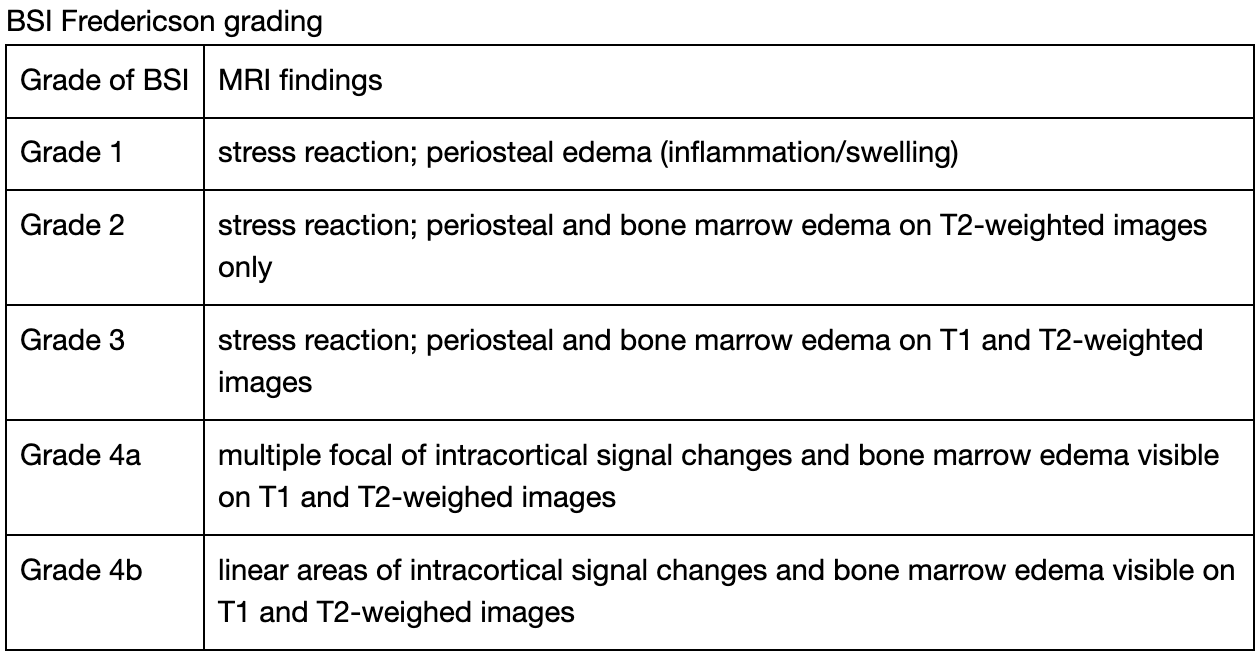
Bone injuries exist on a spectrum. We hear about stress fractures most often because they are one of the more severe bone injuries, but there are less severe variations that we still need to take seriously. Bone stress injuries are graded on a scale from 1-4. Grades 1-3 are called stress reactions and a grade 4 is a stress fracture. A stress fracture can progress to a full fracture if not addressed quickly. This is why timely diagnosis is of utmost importance.
Testing/Imaging
The only way we can truly diagnose a bone injury is by imaging. A physio well-versed in running and/or bone injuries can complete tests that give us an idea that we’re dealing with a bone injury, but imaging is how we confirm and then grade that injury.
X-rays are often the first step in the imaging process. This is partly due to them being good at detecting full fractures, which we want to rule out, but also because insurance companies are less likely to cover MRI costs without doing an x-ray first.
If you’re a runner who is concerned about a bone injury, this cannot be the last step in the investigation process. X-rays are not sensitive enough to detect early (low grade) bone injuries. They don’t pick up bone swelling well. We cannot rule out a stress fracture or stress reaction with an x-ray. An MRI is the gold standard imaging for bone injuries.
Cool tidbit–
Physios in Tennessee can now order imaging for their patients. That’s another positive step to getting a quicker diagnosis for injured runners.
Sources
Fredericson et al. 1995.